
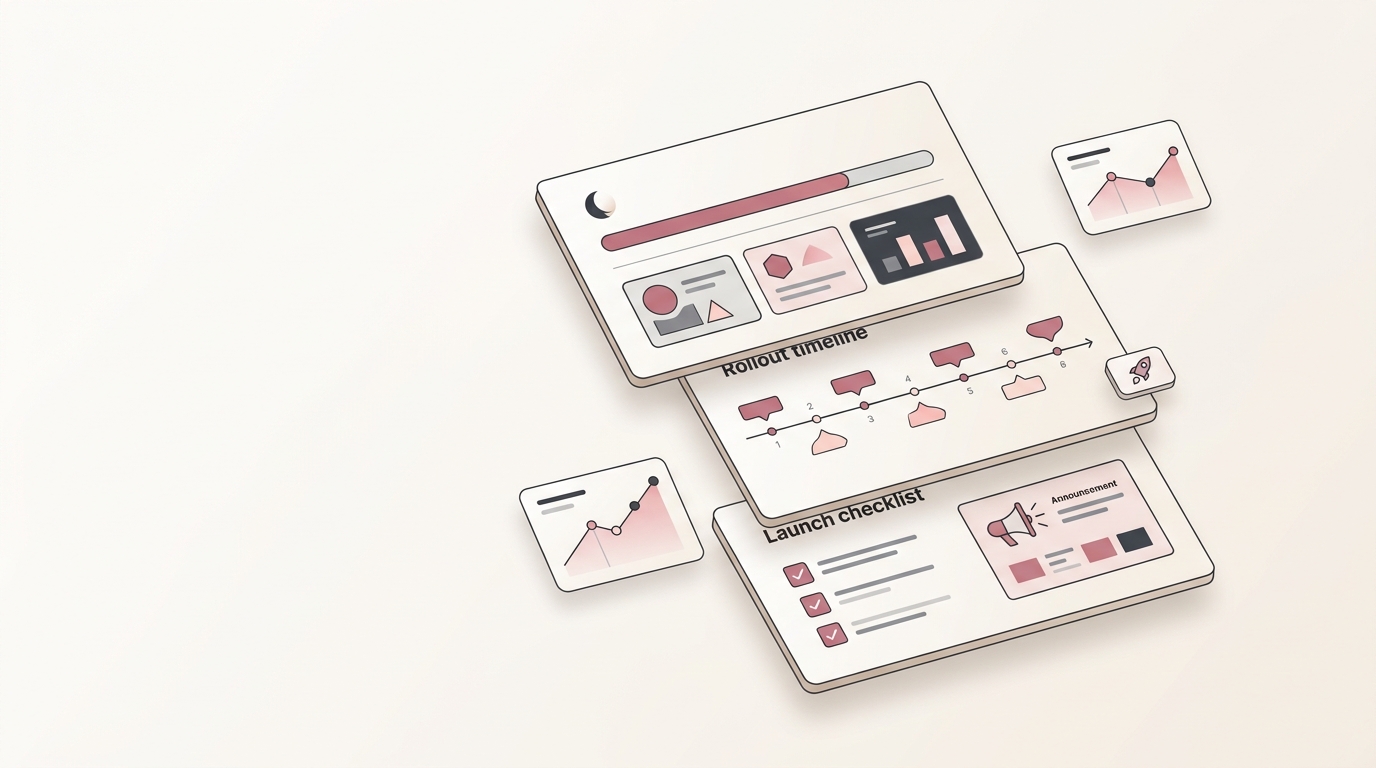
Get Your AI Product Launch Deck Generator for Go-to-Market Needs
Upload an existing PPTX file. Get an AI product launch deck generator that creates the next version while preserving slide flow, visual rhythm, and narrative structure.
What this Product launch deck generator creates
- Launch narrative, audience framing, and feature story.
- Go-to-market sections, timeline, and rollout plan.
- Visual treatment for product screenshots and messaging.
- Stakeholder-ready summaries and announcement flow.
What the generator preserves from your reference file
Upload a previous launch deck that shows the message structure and rollout detail you want.
What you can change in each generated version
- Product name, audience, positioning, and launch date.
- Feature list, proof points, and rollout milestones.
- CTA for sales, marketing, enablement, or leadership.
Example product launch deck generator scenarios
- Product marketers preparing launch enablement.
- Startups reusing their best launch narrative.
- Teams turning release notes into presentation-ready decks.
Manual Product launch deck workflows are slow because structure keeps drifting
A strong product launch deck is not just a block of generated text. It is a repeatable workflow with structure, formatting, decision logic, and a familiar review path. The hard part is keeping that consistency when the next version needs new inputs, a new audience, or a new reporting period.
WriteAsMe solves this by starting from the finished file you already trust. Instead of asking a chat model to invent a generic product launch deck, it uses your reference file as the operating pattern, then generates the next version with repeatable structure and controlled changes.
Slides drift away from the approved story
Manual deck edits often preserve the surface design while changing the sequence, pacing, or proof structure that made the original persuasive.
Master-slide formatting gets patched by hand
Teams duplicate slides, resize charts, and repair typography one by one, which creates inconsistent spacing and version-to-version design debt.
Metrics and narrative updates happen in separate passes
The data changes first, the executive story changes later, and the final review becomes a hunt for mismatched labels, claims, and visuals.
How WriteAsMe understands this presentation workflow
WriteAsMe treats the product launch deck as a structured presentation system. It tracks slide order, recurring section purpose, visual hierarchy, chart placement, title logic, and the way proof points support the story. For a new version, it can preserve the presentation's structure while adapting product name, audience, positioning, and launch date. and keeping the deck consistent enough for review without rebuilding every slide.
Who uses this repeatable workflow?
Founders and executives
Leadership teams can refresh investor, review, and launch decks while keeping the same storyline and board-ready visual polish.
Sales and go-to-market teams
Revenue teams can adapt proven pitch and launch narratives for new accounts, segments, and product contexts.
Product marketing and strategy teams
Teams responsible for repeated internal and external decks can standardize slide rhythm without flattening the message.
Step-by-Step Implementation Guide for Product launch deck
Use this workflow when the goal is consistency, not a one-off draft. The setup below keeps slide structure, audience adaptation, and presentation consistency aligned from one version to the next.
Upload the strongest finished example
Upload a previous launch deck that shows the message structure and rollout detail you want. The reference should show the exact structure, formatting, and level of detail you want WriteAsMe to replicate.
Identify what must remain stable
Mark the parts that define the workflow: Launch narrative, audience framing, and feature story. Go-to-market sections, timeline, and rollout plan. Visual treatment for product screenshots and messaging. Stakeholder-ready summaries and announcement flow. These become the reusable structure for future generations.
Provide the new inputs in one clear prompt
Change the variables that belong to this run, including Product name, audience, positioning, and launch date. Feature list, proof points, and rollout milestones. CTA for sales, marketing, enablement, or leadership. This keeps the prompt focused on controlled updates instead of rebuilding the file.
Review, save, and reuse the workflow
Check the generated product launch deck for accuracy, then keep the workflow as the repeatable version for the next cycle, client, role, or scenario.
Industry Best Practices for Consistent Product launch deck Generation
- Keep one approved deck as the narrative source of truth, then change audience, metrics, and proof points without altering the slide logic that already works.
- Start from an editable PPTX when you need layout, master-slide treatment, and chart rhythm preserved.
- Keep one slide per idea so the workflow can map each section to a clear narrative role.
This is for repeatable work, not one-off drafting.
A normal AI chat can draft a generic product launch deck. WriteAsMe starts from your own finished file, then preserves the structure, formatting, formulas, charts, section logic, and writing pattern that made it useful.
That means the next version does not begin with re-explaining the template. You upload a trusted example once, change the inputs, and generate a document that follows the same workflow.
FAQ
Do I need a perfect product launch deck to start?
No. A clear finished example is enough. Editable Office files work best when you want to preserve formulas, charts, layouts, or section structure.
Can I change the output after generation?
Yes. You can adjust the prompt, change the inputs, or regenerate a new version from the same workflow.
Will my uploaded files train shared AI models?
No. Your files are used to create and run your own reusable workflow. They are not used to train shared models for other customers.
Related use cases
Turn one polished fundraising deck into tailored versions for different investors, stages, or markets.
Reuse a winning deck for a new client, product, or market - with the same storyline, slide flow, and visual style.
Generate the next business review from a past one - with updated KPIs, insights, risks, and action items.
Make your next product launch deck repeatable.
Upload one finished file, turn it into a reusable workflow, and generate the next version with your structure intact.